Table of Contents
The Roman Empire: Expansion, Engineering, and Everyday Life
The Roman Empire stands as one of the most influential and enduring civilizations in human history. From its legendary founding in 753 BCE to the fall of Constantinople in 1453 CE, Roman civilization shaped the political, cultural, and architectural landscape of three continents for over two millennia. At its territorial zenith under Emperor Trajan in 117 CE, the empire stretched from the misty borders of Scotland to the sun-scorched deserts of Mesopotamia, from the Atlantic shores of Iberia to the banks of the Euphrates River.
This vast dominion encompassed an estimated 50 to 90 million people—nearly one-quarter of the world’s population at the time—united under Roman law, protected by Roman legions, connected by Roman roads, and influenced by Roman culture. The empire’s legacy extends far beyond its temporal boundaries, profoundly shaping Western civilization’s legal systems, languages, architecture, engineering, military strategy, and political philosophy.
Understanding the Roman Empire requires examining not just the grand narrative of conquest and decline, but also the intricate details of daily existence: how people worked, worshipped, entertained themselves, and organized their societies. It means exploring the revolutionary engineering that brought fresh water to cities, the military innovations that conquered diverse peoples, and the cultural adaptations that held a multicultural empire together for centuries.
This comprehensive exploration delves into the expansion that created the empire, the engineering marvels that sustained it, the everyday experiences of its inhabitants, and the lasting legacy that continues to influence our modern world. From the Forum to the frontier, from patrician villas to plebeian apartments, from triumphal arches to humble taverns, we’ll examine how Rome built, maintained, and ultimately lost the greatest empire of the ancient world—and why it still matters today.
The Rise of Rome: From City-State to Mediterranean Superpower
The Foundations: Mythical Origins and Early Rome
According to legend, Rome was founded on April 21, 753 BCE, by the twin brothers Romulus and Remus, who were raised by a she-wolf after being abandoned as infants. While modern historians recognize this foundation story as mythological, it reveals much about how Romans understood their own character: fierce, martial, and blessed by divine favor.
Archaeological evidence suggests Rome began as a collection of Latin and Sabine villages on the seven hills overlooking the Tiber River. Its strategic location—at the first convenient crossing point of the Tiber, fifteen miles inland from the coast—provided natural defenses while enabling trade between the interior and the sea.
Early Rome was ruled by kings, beginning with Romulus and continuing through seven legendary monarchs. The last three kings were Etruscan, reflecting the influence of Rome’s more sophisticated northern neighbors. This monarchical period lasted until 509 BCE, when the Romans expelled their last king, the tyrannical Tarquinius Superbus, and established the Roman Republic.
The Roman Republic: Building Power Through Conflict
The Roman Republic (509-27 BCE) represents a formative period during which Rome transformed from a regional power to the master of the Mediterranean world. The Republic’s political system, though oligarchic by modern standards, featured elements that would influence democratic governments centuries later:
Political Structure:
- Two annually elected consuls served as chief executives
- The Senate advised on policy and foreign affairs
- Popular assemblies passed laws and elected officials
- Tribunes protected plebeian interests against patrician power
This system of checks and balances, though imperfect, prevented any single individual from gaining absolute power—until the Republic’s final century, when ambitious generals like Pompey, Julius Caesar, and Octavian would exploit its weaknesses.
The Conquest of Italy (509-264 BCE)
Rome’s expansion began close to home. Through a combination of military conquest and strategic alliances, Rome gradually subdued its Italian neighbors. Key developments included:
The Latin Wars (340-338 BCE): Rome defeated its Latin neighbors and dissolved the Latin League, incorporating these peoples into an expanding Roman confederation. Rather than treating conquered peoples as subjects, Rome often extended partial citizenship and alliance terms, creating a network of loyal communities.
The Samnite Wars (343-290 BCE): Three brutal wars against the fierce Samnite tribes of south-central Italy tested Roman military adaptability. These conflicts drove innovations in tactics and organization that would serve Rome throughout its expansion.
The Pyrrhic War (280-275 BCE): When the Greek city of Tarentum called on King Pyrrhus of Epirus for help against Rome, the Romans faced one of antiquity’s greatest generals and his war elephants. Though Pyrrhus won battles, his casualties were so severe that “Pyrrhic victory” entered the lexicon. Rome’s ability to absorb losses and replenish armies proved decisive.
By 264 BCE, Rome controlled the entire Italian peninsula south of the Po River, commanding a population of perhaps four million and an army that could field multiple legions simultaneously—a military capacity unmatched in the Mediterranean world.
The Punic Wars: Rome Against Carthage
The Punic Wars (264-146 BCE) against the North African maritime power of Carthage represent Rome’s defining struggle for Mediterranean supremacy. These three epic conflicts transformed Rome from a regional Italian power into an empire spanning multiple continents.
The First Punic War (264-241 BCE): Beginning as a dispute over Sicily, this conflict forced Rome, traditionally a land power, to become a naval force. The Romans innovated the corvus (boarding bridge), which allowed their superior infantry to board and capture enemy ships. After 23 years of brutal fighting, Rome emerged victorious, gaining Sicily—its first overseas province.
The Second Punic War (218-201 BCE): This war featured one of history’s most celebrated military commanders: Hannibal Barca. In one of warfare’s most daring gambits, Hannibal led an army—including war elephants—from Spain, through Gaul, and across the Alps into Italy. His brilliant tactical victories at Trebia, Lake Trasimene, and especially Cannae (where he annihilated a Roman army of 50,000-70,000 men) brought Rome to the brink of collapse.
Yet Rome refused to surrender. The Romans adopted a strategy of attrition, avoiding pitched battles while gradually wearing down Hannibal’s forces. The Roman general Scipio Africanus eventually carried the war to Africa, forcing Hannibal to return home, where Scipio defeated him at the Battle of Zama in 202 BCE.
The Third Punic War (149-146 BCE): Driven by the Roman senator Cato the Elder, who famously ended every speech with “Carthage must be destroyed,” Rome launched a final war against its old rival. After a three-year siege, Roman forces captured and utterly destroyed Carthage, allegedly sowing the ruins with salt. The city’s territory became the Roman province of Africa.
These wars established Rome as the Mediterranean’s dominant power and instilled a military confidence that would drive further expansion.
Eastern Expansion: Conquering the Hellenistic World
While fighting Carthage, Rome became increasingly entangled in the politics of the Greek East, where Alexander the Great’s empire had fragmented into several Hellenistic kingdoms.
The Macedonian Wars (214-148 BCE): Four wars against the Kingdom of Macedon culminated in Roman victory and the absorption of Greece and Macedon into the Roman sphere. The Battle of Pydna in 168 BCE demonstrated the superiority of Roman legions over the traditional Greek phalanx.
War Against the Seleucid Empire (192-188 BCE): Rome defeated the Seleucid king Antiochus III, one of Alexander’s successors, at the Battle of Magnesia, establishing Roman dominance over Asia Minor.
Conquest of the Eastern Mediterranean: By the mid-first century BCE, Rome had annexed or established protectorates over:
- Syria (64 BCE)
- Judea (63 BCE)
- Egypt (30 BCE, after Cleopatra’s defeat)
- Asia Minor and Greece (various dates)
These eastern conquests brought enormous wealth to Rome but also introduced Greek culture, philosophy, art, and learning that would profoundly transform Roman civilization. The poet Horace captured this cultural paradox: “Captive Greece took her savage victor captive.”
The Conquest of Gaul and Beyond
Julius Caesar’s Gallic Wars (58-50 BCE): Caesar’s conquest of Gaul (modern France) represents one of history’s most successful military campaigns. In less than a decade, Caesar subdued the diverse Gallic tribes, crossed the Rhine to strike at Germanic peoples, and even invaded Britain (though without establishing lasting control).
Caesar’s commentaries on these wars provide vivid firsthand accounts of military operations, tribal customs, and the challenges of conquering and pacifying vast territories. His campaigns extended Roman power to the Atlantic and the English Channel, adding wealthy provinces and establishing the Rhine as Rome’s northern frontier.
From Republic to Empire: The Augustan Revolution
The Crisis of the Late Republic
By the first century BCE, the Roman Republic faced existential crises. Military commanders like Sulla, Pompey, and Caesar commanded legions loyal to them personally rather than to the state. Political violence became common as the traditional republican framework proved unable to govern an empire stretching across three continents.
The First Triumvirate (60 BCE): Caesar, Pompey, and Crassus formed an unofficial alliance to dominate Roman politics. After Crassus’s death in Parthia and Caesar’s growing power in Gaul, tensions between Caesar and Pompey erupted into civil war.
Caesar’s Civil War (49-45 BCE): In 49 BCE, Caesar crossed the Rubicon River with his army—an act of rebellion since Roman law forbade generals from bringing armies into Italy. His famous declaration, “The die is cast,” signaled the beginning of civil war. Caesar defeated Pompey and his allies, becoming dictator of Rome.
Caesar’s Assassination (44 BCE): Fearing Caesar planned to make himself king, a group of senators led by Brutus and Cassius assassinated him on the Ides of March (March 15), 44 BCE. Rather than restoring the Republic, this act triggered another round of civil wars.
The Age of Augustus: The Empire Begins
The Second Triumvirate and Final Civil Wars (43-31 BCE): Caesar’s lieutenant Mark Antony, his adopted heir Octavian, and Lepidus formed the Second Triumvirate to defeat Caesar’s assassins and divide power. After eliminating their enemies (including the great orator Cicero), the triumvirs turned on each other. Antony allied with Egypt’s Queen Cleopatra, while Octavian portrayed himself as the defender of Roman traditions against eastern decadence.
The Battle of Actium (31 BCE): Octavian’s forces defeated Antony and Cleopatra’s fleet off the coast of Greece. The couple fled to Egypt, where both committed suicide the following year. Octavian now stood as Rome’s sole ruler.
The Augustan Settlement (27 BCE): In a carefully orchestrated political theater, Octavian claimed to “restore the Republic,” returning power to the Senate and people. In gratitude, the Senate granted him the title Augustus (“the revered one”) and extended his authority over most of Rome’s armies and provinces. While maintaining republican forms, Augustus had effectively become Rome’s first emperor.
Augustus’s reign (27 BCE – 14 CE) established the framework for imperial government that would endure for centuries:
- The Pax Romana (Roman Peace) brought relative stability
- Provincial administration became more efficient and less exploitative
- The army became a professional, salaried force loyal to the emperor
- Building projects beautified Rome (“I found Rome a city of brick and left it a city of marble”)
- Literature and arts flourished under imperial patronage
- The empire’s frontiers were secured and, in some cases, expanded
The Height of Roman Power: The Five Good Emperors
The period from 96 to 180 CE, often called the age of the Five Good Emperors, represents the Roman Empire at its zenith of power, prosperity, and territorial extent.
Nerva (96-98 CE)
The elderly senator Nerva became emperor after the assassination of the unpopular Domitian. His brief reign established the precedent of adoption: rather than passing power to biological heirs, emperors would adopt the most capable successor. This practice would ensure competent leadership for nearly a century.
Trajan (98-117 CE)
The first emperor born outside Italy (in Spain), Trajan proved an energetic military leader and administrator. His conquests brought the empire to its greatest territorial extent:
Dacian Wars (101-102, 105-106 CE): Trajan conquered Dacia (modern Romania), gaining access to its rich gold mines. The victory is commemorated by Trajan’s Column in Rome, a detailed visual record of the campaigns carved in a continuous spiral frieze.
Parthian War (113-117 CE): Trajan invaded the Parthian Empire, briefly conquering Mesopotamia and reaching the Persian Gulf—Rome’s furthest eastern expansion. However, these gains proved temporary, as revolts and military difficulties forced his successor to abandon most conquests.
Trajan earned a reputation as an ideal emperor, leading the Senate to wish later emperors to be “more fortunate than Augustus, better than Trajan.”
Hadrian (117-138 CE)
Trajan’s adopted heir, Hadrian, reversed his predecessor’s expansionist policy, consolidating and fortifying the empire’s frontiers. His reign emphasized:
Defensive Strategy: Rather than further conquest, Hadrian built fortifications marking and protecting Rome’s borders. The most famous is Hadrian’s Wall in Britain, a 73-mile stone barrier marking the empire’s northernmost frontier.
Cultural Patronage: A philhellene who admired Greek culture, Hadrian rebuilt the Pantheon in Rome, constructed magnificent buildings throughout the empire, and traveled extensively to inspect provinces personally.
Administrative Reforms: Hadrian systematized Roman law, created a professional bureaucracy, and improved provincial government.
Antoninus Pius (138-161 CE)
The reign of Antoninus Pius represented perhaps the most peaceful period in Roman history. For 23 years, the empire enjoyed stability, prosperity, and minimal military conflict. Antoninus governed efficiently, maintained the frontiers, and earned his cognomen “Pius” (dutiful) for his respect for tradition and institutions.
Marcus Aurelius (161-180 CE)
The philosopher-emperor Marcus Aurelius is remembered both as a Stoic thinker whose “Meditations” remain influential and as a ruler who spent much of his reign campaigning against threats to the empire.
The Marcomannic Wars: Germanic tribes crossed the Danube, penetrating deep into Roman territory and even besieging Aquileia in northern Italy. Marcus spent years on the frontier, pushing back the invaders and securing the border. He died in 180 CE while on campaign, ending the era of the Five Good Emperors.
Philosophical Legacy: Despite the burden of rule and constant warfare, Marcus wrote philosophical reflections that emphasize duty, rationality, and acceptance of fate—principles that helped him endure the challenges of leadership.
The death of Marcus Aurelius marked a turning point. His son Commodus lacked his father’s wisdom and virtue, and his disastrous reign (180-192 CE) signaled the end of the empire’s golden age.
Roman Military Excellence: The Legions That Conquered an Empire
Rome’s military prowess was legendary, and rightfully so. The Roman legions represented perhaps the most effective military organization in ancient history, combining discipline, training, adaptability, and logistical sophistication in ways unmatched by their enemies.
Structure and Organization of the Legion
The basic unit of Roman military power was the legion, a formation of approximately 5,000 heavy infantry soldiers (legionaries) supported by auxiliary troops.
Legion Structure:
- 10 cohorts per legion
- 6 centuries per cohort (except the first cohort, which had 5 double-strength centuries)
- 80 men per century (despite the name suggesting 100)
- Each century commanded by a centurion
Unit Hierarchy:
- Legatus: Legion commander, typically a senator
- Tribunus laticlavius: Senior tribune, second-in-command
- Praefectus castrorum: Camp prefect, responsible for logistics and training
- Centurions: Backbone of the army, experienced officers commanding centuries
- Optio: Assistant to the centurion
- Signifer: Standard-bearer, also handled soldiers’ savings
- Cornicen: Horn-blower for battlefield signals
This hierarchical structure ensured clear command chains while allowing tactical flexibility at lower levels.
Training and Discipline
Roman soldiers underwent rigorous training that created formidable fighting men:
Physical Conditioning: Recruits marched 20 miles in five hours wearing full armor and equipment (approximately 50 pounds). They trained with swords and shields heavier than combat weapons, making actual combat seem easier.
Weapons Drill: Soldiers practiced sword techniques against wooden posts, learning the Roman fighting style that emphasized thrusting rather than slashing—more lethal and less tiring in formation combat.
Unit Drill: Legions practiced complex formations and maneuvers until they could execute them instinctively in the chaos of battle. This coordination gave Roman armies decisive advantages over less disciplined opponents.
Engineering Training: Every legionary learned basic engineering. Armies could construct fortified camps in hours, build bridges, create siege weapons, and even construct roads—skills that extended Roman power into remote regions.
Discipline: Roman military discipline was harsh but effective. Punishments for cowardice or mutiny could be severe, including decimation (executing every tenth man in a unit that had disgraced itself). However, this strictness created armies that rarely broke in battle.
Tactics and Strategy
The Triplex Acies: The standard Roman battle formation deployed legionaries in three lines:
- Hastati: Younger soldiers in the front
- Principes: Experienced troops in the second line
- Triarii: Veterans in reserve (“It has come to the triarii” meant a desperate situation)
This system allowed fresh troops to replace tired ones, maintaining pressure on enemies.
The Testudo (Tortoise): When facing missile fire, Roman soldiers interlocked shields above and around them, creating a nearly impenetrable shell that allowed safe approach to walls or enemy positions.
Battlefield Flexibility: Unlike the rigid Greek phalanx, Roman formations could maneuver, adapt to terrain, and reform after disruption—crucial advantages in the varied conditions of ancient warfare.
Siege Warfare: Romans excelled at siege craft, building towers, rams, catapults, and mining tunnels. Their systematic approach to reducing fortifications made few cities truly impregnable.
The Auxiliaries
Alongside the citizen legions, Rome employed auxiliary units recruited from non-citizen populations:
- Cavalry: Often recruited from horsemen cultures like Gauls, Numidians, or Sarmatians
- Light infantry: Archers, slingers, and skirmishers from various provinces
- Specialized units: Camel riders, swimmers, and other specialists
Auxiliaries typically received citizenship upon honorable discharge after 25 years of service, helping integrate diverse populations into the empire. By the late empire, auxiliaries outnumbered legionaries and formed increasingly important components of Roman military power.
Logistics: The Secret of Roman Success
Perhaps Rome’s greatest military advantage was logistical sophistication. Roman armies could campaign hundreds of miles from home for years because they mastered the art of keeping soldiers supplied, paid, and equipped.
Supply Lines: Rome’s road network allowed rapid movement of supplies. Grain, weapons, armor, and other necessities flowed along these routes to frontier armies.
Depots and Granaries: Strategically placed supply depots ensured armies could replenish even in remote regions.
Naval Supply: Rome’s control of the Mediterranean enabled water transport—much more efficient than overland—to coastal provinces.
Living Off the Land: When possible, armies obtained food locally through requisition or purchase, reducing transport requirements.
Pay and Retirement: Roman soldiers received regular pay and, upon retirement, either cash bonuses or land grants. This system created veteran colonies throughout the empire, spreading Roman culture while providing security.
Engineering Marvels: How Rome Built an Empire
Roman engineering achievements remain impressive two millennia later. The Romans were master builders whose practical, systematic approach to construction problems created infrastructure that served millions and, in some cases, still functions today.
The Roman Road Network: All Roads Lead to Rome
Rome’s most extensive and influential engineering achievement was its road system, eventually spanning over 250,000 miles throughout the empire. These weren’t simple dirt paths but sophisticated, engineered highways built to exacting standards.
Construction Methods: Roman roads followed a consistent construction pattern:
- Excavation: Workers dug a trench several feet deep
- Foundation: Large stones (statumen) formed the base layer
- Middle layers: Smaller stones, gravel, and sand (rudus and nucleus) created stable intermediate layers
- Surface: Carefully fitted paving stones (summa crusta) created a smooth, durable surface
This multi-layer construction drained water, distributed weight, and created roads that could last centuries with minimal maintenance.
Engineering Innovations:
- Roads were slightly crowned (higher in the middle) to drain water
- Milestones marked distances
- Drainage ditches prevented water damage
- Bridges and tunnels overcame obstacles
- Rest stops (mansiones) provided accommodation every 15-20 miles
Strategic Purpose: Roman roads served primarily military needs:
- Legions could march rapidly to trouble spots
- Messages and orders traveled quickly via mounted couriers
- Supply wagons could reach remote garrisons
Economic Impact: Roads also enabled commerce, spreading prosperity throughout the empire. Merchants could transport goods safely across vast distances, creating an integrated Mediterranean economy.
Famous Roads:
- Via Appia (Appian Way): Called the “Queen of Roads,” built in 312 BCE, connecting Rome to southern Italy
- Via Flaminia: Northern route to the Adriatic
- Via Augusta: Ran the length of Spain
- Via Egnatia: Connected the Adriatic to Byzantium
Some Roman roads remain in use today, nearly 2,000 years later—testament to Roman engineering skill.
Aqueducts: Bringing Water to Cities
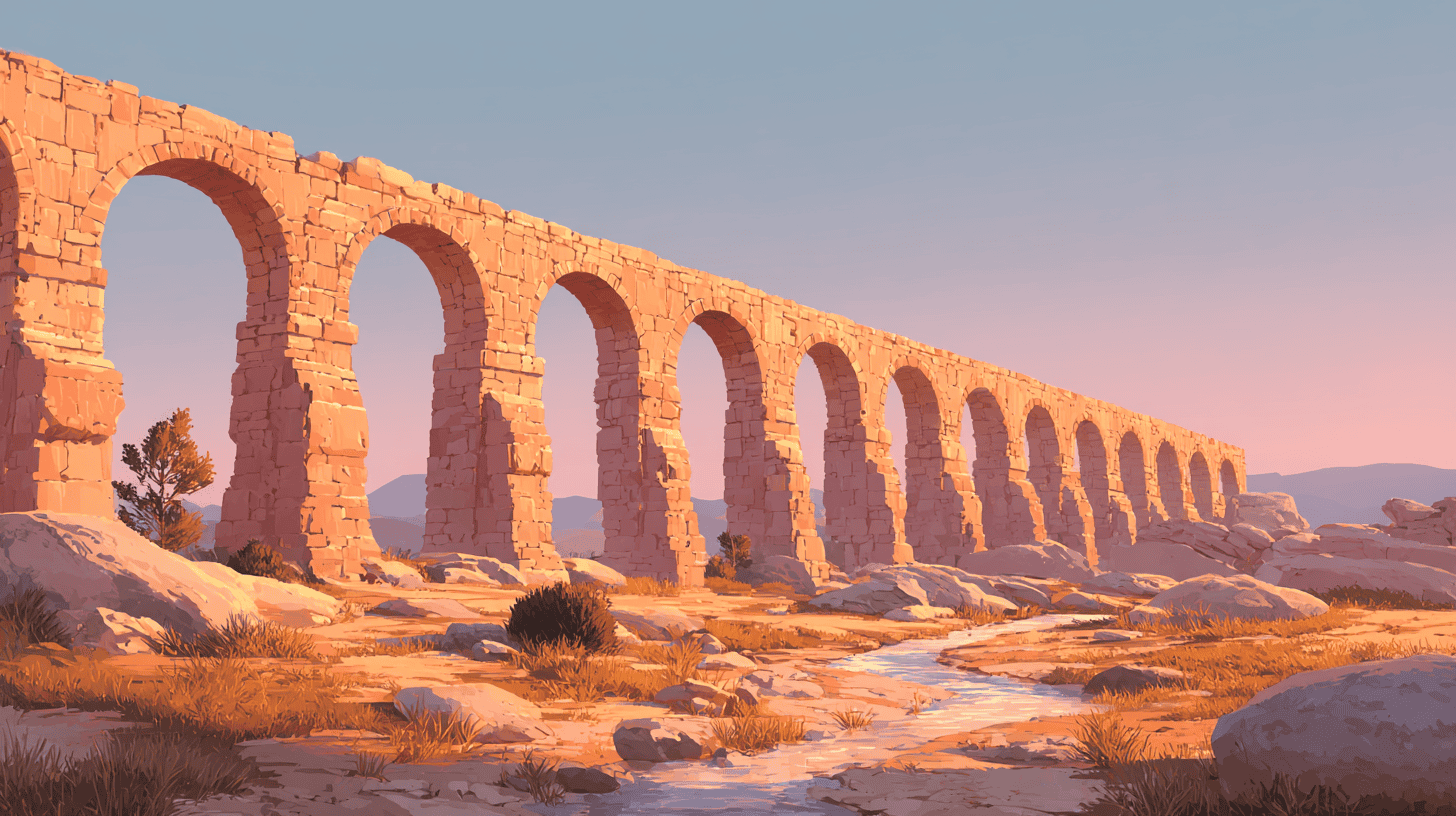
Rome’s aqueducts rank among antiquity’s most impressive engineering achievements. These massive structures transported fresh water from mountain sources to cities, sometimes across dozens of miles of varied terrain.
How Aqueducts Worked: Roman aqueducts used gravity to move water, requiring precise calculation of gradients:
- Typical gradient: 1-3 meters drop per kilometer
- Water flowed in covered channels to prevent contamination
- Settling tanks removed sediment
- Distribution systems directed water to fountains, baths, and private homes
Engineering Challenges: Aqueduct builders overcame significant obstacles:
- Valleys: Massive arcade structures (the iconic arched aqueduct bridges) carried water across lowlands
- Hills: Tunnels bored through obstacles
- Distance: Careful surveying maintained proper gradient over many miles
Famous Aqueducts:
- Aqua Appia: Rome’s first aqueduct (312 BCE), mostly underground
- Aqua Claudia: Featured spectacular arcades bringing water 45 miles to Rome
- Pont du Gard: Three-tiered arcade in southern France, 160 feet high, still standing
- Segovia Aqueduct: Magnificent structure in Spain, still supplying water until recently
Impact on Urban Life: Abundant water transformed Roman cities:
- Public fountains provided free water to all
- Baths became central to social life
- Sanitation systems improved public health
- Fountains, pools, and decorative waterworks enhanced cities aesthetically
Rome itself eventually had 11 aqueducts supplying approximately 300 gallons per person per day—far more than many modern cities provide.
Roman Concrete: Revolutionary Building Material
The Romans developed opus caementicium (Roman concrete), a revolutionary building material that enabled their most impressive structures.
Composition: Roman concrete mixed:
- Lime mortar
- Volcanic ash (pozzolana)
- Aggregate (stones, rubble, or broken brick)
The volcanic ash reacted chemically with lime, creating an exceptionally strong, durable material. Recent studies suggest Roman concrete actually strengthens over time, especially when exposed to seawater—a property modern concrete lacks.
Construction Advantages:
- Could be poured into forms, enabling complex shapes
- Required less skilled labor than stone masonry
- Utilized local materials, reducing costs
- Created monolithic structures of tremendous strength
- Enabled large-scale building projects
Applications: Roman concrete made possible:
- Massive domes (the Pantheon)
- Multi-story apartment buildings
- Harbor installations
- Bridges and aqueducts
- Defensive walls
The technology was lost after Rome’s fall and not fully replicated until the modern era, leading to the Pantheon’s dome remaining the world’s largest unreinforced concrete dome for 1,800 years.
Monumental Architecture: Buildings That Defined an Empire
Roman architecture combined engineering prowess with aesthetic ambition, creating structures that awed contemporaries and continue to impress today.
The Colosseum (72-80 CE): The Flavian Amphitheater, commonly called the Colosseum, exemplifies Roman engineering at its finest:
- Held 50,000-80,000 spectators
- Featured 80 entrance arches enabling rapid filling and emptying
- Included retractable awning (velarium) for sun protection
- Underground passages (hypogeum) housed gladiators and animals
- Hydraulic systems could flood the arena for mock naval battles
- Sophisticated use of arches, vaults, and concrete
The Colosseum’s elliptical design and tiered seating plan influenced stadium design for two millennia.
The Pantheon (118-128 CE): Built under Hadrian, the Pantheon represents perhaps Rome’s greatest architectural achievement:
- Features the world’s largest unreinforced concrete dome (142 feet in diameter)
- Oculus (30-foot opening at the dome’s apex) provides the only light
- Perfect proportions: height equals diameter, creating a perfect sphere
- Remains in continuous use for nearly 2,000 years
- Inspired countless later buildings, including the U.S. Capitol
The Pantheon’s construction techniques remain impressive: the concrete gets progressively lighter from base to apex, with heavy aggregate giving way to pumice, reducing weight while maintaining strength.
Triumphal Arches: Romans erected arches to celebrate military victories:
- Arch of Titus: Commemorates the sack of Jerusalem (70 CE)
- Arch of Septimius Severus: Celebrates Parthian victories
- Arch of Constantine: Last great triumphal arch of Rome
These monuments established an architectural form that would influence ceremonial architecture worldwide.
Roman Baths: Massive bath complexes served as social centers:
- Baths of Caracalla: Could accommodate 1,600 bathers, included libraries, gardens, and gyms
- Baths of Diocletian: Even larger, with pools, exercise rooms, and social spaces
- Featured sophisticated heating systems (hypocausts) with underfloor heating
- Demonstrated Roman hydraulic engineering expertise
Temples and Forums:
- Forums served as civic centers with temples, courts, and markets
- Trajan’s Forum: Largest and most elaborate, with markets, libraries, and basilica
- Temples showcased various architectural styles adapted from Greek models
Urban Planning: Designing Roman Cities
Roman urban planning followed consistent principles that created functional, organized cities throughout the empire:
Grid Layout: Most Roman cities used a grid pattern with two main streets:
- Cardo: Main north-south street
- Decumanus: Main east-west street
- Their intersection formed the city center
Essential Elements: Every Roman city included:
- Forum: Central public square for civic life
- Basilica: Large public building for administration and commerce
- Baths: Public bathing complexes
- Theater/Amphitheater: Entertainment venues
- Temples: Religious buildings
- Markets: Commercial spaces
- Aqueducts and fountains: Water infrastructure
Residential Districts:
- Wealthy citizens lived in domus (single-family homes with courtyards)
- Most urban dwellers lived in insulae (multi-story apartment buildings)
- Suburbs outside walls housed poorer residents and businesses
This standardized approach meant Roman citizens could recognize familiar patterns whether in Britain, Syria, or North Africa, reinforcing cultural unity across the empire.
Daily Life in the Roman Empire: From Dawn to Dusk
Beyond grand monuments and military conquests, the Roman Empire consisted of millions of individuals living ordinary lives. Understanding daily existence reveals how this civilization actually functioned and what life meant for its inhabitants.
Social Hierarchy: Orders and Classes
Roman society was rigidly hierarchical, with clearly defined social orders that determined legal rights, economic opportunities, and social relationships.
The Emperor and Imperial Family: At the apex stood the emperor (princeps or imperator) and his family. The emperor held supreme power as commander-in-chief, chief priest, and ultimate legal authority. Imperial family members enjoyed enormous prestige and influence, though their positions could be precarious given succession politics.
Senators (Ordo Senatorius): The senatorial class consisted of Rome’s wealthiest and most prestigious citizens:
- Required property of at least 1,000,000 sesterces
- Held top government positions and military commands
- Wore togas with a broad purple stripe
- Enjoyed legal privileges and exemptions
- Numbered only a few thousand families
Equestrians (Ordo Equester): The equestrian order formed Rome’s business class:
- Required property of 400,000 sesterces
- Filled middle administrative positions
- Engaged in commerce and business (considered beneath senatorial dignity)
- Wore togas with narrow purple stripes
- Increasingly important in imperial administration
Plebeians (Common Citizens): Free-born Roman citizens without senatorial or equestrian status:
- Worked as artisans, shopkeepers, farmers, soldiers
- Enjoyed legal rights including voting and property ownership
- Ranged from comfortable to impoverished
- Constituted the bulk of the citizen population
Freedmen (Liberti): Freed slaves retained some obligations to former masters but could:
- Own property and conduct business
- Marry and raise free-born children
- Sometimes accumulate considerable wealth
- Not serve in legions (though eligible for other military service)
Slaves (Servi): Slavery formed an integral part of the Roman economy:
- Estimated 25-40% of Italy’s population were slaves
- Came from conquest, piracy, birth, or debt
- Performed all types of labor from mining to tutoring
- Treatment varied widely depending on owner and work
- Could be freed (manumitted) through various means
This hierarchy wasn’t absolutely rigid—wealth and imperial favor could elevate individuals—but it fundamentally structured Roman society.
The Roman Family: Structure and Values
The familia (family) formed the basic unit of Roman society, though its structure differed significantly from modern nuclear families.
The Paterfamilias: The male head of household (paterfamilias) wielded legal authority over all family members:
- Owned all family property
- Could arrange marriages for children
- Theoretically held power of life and death (rarely exercised)
- Made religious offerings to household gods
- Represented family in legal matters
Household Composition: A typical household included:
- Paterfamilias and his wife
- Unmarried daughters
- Sons and their wives and children (if living together)
- Slaves and freedmen
- Sometimes extended relatives or clients
Women’s Roles: Roman women had more freedom than Greek counterparts but remained legally subordinate:
- Managed households and supervised slaves
- Could own property (though control often required male guardian)
- Educated women might engage in literature or philosophy
- Some wielded significant informal influence
- Imperial women (like Livia or Agrippina) could exercise considerable power
Marriage and Children:
- Marriages arranged for family advantage, especially among elite
- Legitimate children inherited status and property
- High infant mortality meant large families necessary for heirs
- Sons provided family continuity; daughters forged alliances
- Adoption common, especially among elite lacking heirs
Roman Names: Romans typically had three names (tria nomina):
- Praenomen: Personal name (e.g., Marcus)
- Nomen: Family name (e.g., Tullius)
- Cognomen: Branch of family or nickname (e.g., Cicero)
This naming system identified family lineage and social connections.
Housing: From Palaces to Apartments
Roman housing varied dramatically based on wealth and location.
The Domus (Urban Townhouse): Wealthy urbanites lived in domus, single-family homes built around courtyards:
- Atrium: Central hall with opening (compluvium) and pool (impluvium) for rainwater
- Tablinum: Study/reception room
- Triclinium: Dining room with three couches
- Cubicula: Small bedrooms
- Peristyle: Columned garden courtyard
- Often included shops renting street frontage
Interiors featured:
- Mosaic floors with geometric or pictorial designs
- Frescoed walls with mythological scenes or architectural illusions
- Limited furniture (most activities occurred on couches or benches)
- Minimal privacy by modern standards
The Villa: Country estates (villae) served elite families as:
- Agricultural centers managing farm production
- Leisure retreats from urban life
- Status symbols displaying wealth
Grand villas might include:
- Extensive gardens and fountains
- Private baths
- Libraries
- Elaborate frescoes and mosaics
- Separate quarters for family, guests, and slaves
The Insula (Apartment Building): Most urban Romans lived in insulae, multi-story apartment buildings:
- 3-7 stories tall (height restrictions varied)
- Ground floor often housed shops
- Upper floors divided into smaller, cheaper apartments
- Wealthier tenants lived on lower floors (fewer stairs)
- Top-floor rooms were hot in summer, cold in winter
- Fire and collapse risks considerable
- Communal toilets and cooking facilities
- No running water above ground floor
Living conditions in insulae ranged from comfortable (lower-floor apartments) to squalid (cramped top-floor rooms).
Work and Economy: Making a Living
The Roman economy was diverse, ranging from subsistence agriculture to sophisticated commerce.
Agriculture: Farming formed the economic base:
- Grain production (wheat, barley) was fundamental
- Olive oil and wine generated significant trade
- Livestock provided meat, leather, and wool
- Large estates (latifundia) used slave labor
- Small farmers struggled to compete
Crafts and Manufacturing: Artisans produced goods in small workshops:
- Pottery, glassware, and metalwork
- Textiles and clothing
- Leather goods and shoes
- Furniture and tools
- Many crafts organized into collegia (guilds)
Trade and Commerce: The empire’s size enabled extensive trade networks:
- Mediterranean shipping connected provinces
- Road system facilitated overland commerce
- Common currency (denarius, sestertius, aureus) enabled transactions
- Banking and credit supported large-scale commerce
Trade Goods:
- Grain: Egypt and North Africa supplied Rome
- Wine and olive oil: Spain, Italy, Greece produced premium products
- Luxury goods: Silk from China, spices from India, amber from the Baltic
- Slaves: War captives and trade supplied labor markets
- Building materials: Marble from Greece, timber from forests
Professions: Romans worked in various occupations:
- Doctors and teachers (often Greek-educated)
- Lawyers and advocates (important in litigious society)
- Architects and engineers
- Bankers and merchants
- Civil servants and bureaucrats
Working Conditions:
- Workday typically dawn to mid-afternoon
- Afternoons reserved for leisure, baths, and socializing
- No weekends (Roman week was 8 days)
- Numerous religious festivals provided breaks
- Working conditions harsh for slaves and laborers
Religion: Gods, Temples, and Festivals
Roman religion permeated daily life, linking individuals to family, community, and state through ritual observance.
The Roman Pantheon: Romans worshipped numerous gods adapted from Greek and other sources:
Major deities:
- Jupiter: King of gods, associated with the sky and thunder (Greek Zeus)
- Juno: Queen of gods, protector of women and marriage (Greek Hera)
- Minerva: Goddess of wisdom and war (Greek Athena)
- Mars: God of war (Greek Ares)
- Venus: Goddess of love and beauty (Greek Aphrodite)
- Neptune: God of the sea (Greek Poseidon)
- Apollo: God of sun, music, and prophecy (Greek Apollo)
- Diana: Goddess of the hunt (Greek Artemis)
Religious Practice: Roman religion focused on ritual correctness rather than belief:
- Prayers and sacrifices to gain divine favor
- Priests managed temples and ceremonies
- State religion linked to political life
- Private household worship at shrines to Lares (household gods) and Penates (pantry gods)
Festivals: Romans celebrated numerous religious festivals (feriae):
- Saturnalia (December): Week-long festival with role reversals and gift-giving
- Lupercalia (February): Fertility festival
- Floralia (April-May): Celebration of spring
- These festivals combined religious observance with public entertainment
Emperor Worship: Deceased emperors were often deified (declared gods). In provinces, imperial cult worship demonstrated loyalty to Rome. This requirement later conflicted with Christian monotheism.
Mystery Religions: Beyond official religion, mystery cults attracted followers:
- Cult of Isis: Egyptian goddess promising afterlife rewards
- Mithraism: Persian god popular among soldiers
- Cult of Cybele: Anatolian mother goddess
- These cults offered personal spiritual experiences beyond state religion
The Rise of Christianity: Christianity emerged in Judea during Augustus’s reign and spread gradually:
- Initially persecuted as threatening social order
- Constantine legalized Christianity (313 CE)
- Theodosius made Christianity the official state religion (380 CE)
- Christian church eventually filled vacuum as imperial authority declined
This religious transformation profoundly changed Roman culture, replacing polytheistic tolerance with monotheistic orthodoxy.
Entertainment: Bread and Circuses
Romans enjoyed diverse entertainments that combined spectacle, sport, and social bonding. Emperors sponsored elaborate games to maintain popularity—hence “bread and circuses.”
Gladiatorial Combat: Gladiatorial games originated as funeral rites but became spectacular entertainment:
- Types of gladiators:
- Murmillo: Helmeted fighter with rectangular shield
- Retiarius: Net and trident fighter with minimal armor
- Thraex: Curved sword fighter with small shield
- Secutor: Pursuer designed to fight retiarius
- Gladiators trained in specialized schools (ludi)
- Some were slaves or prisoners, others volunteers seeking fame
- Successful gladiators became celebrities
- Death rates varied—possibly only 10-20% of bouts ended fatally
- Thumb gestures (pollice verso) may have indicated mercy or death
The Amphitheater: Beyond gladiatorial combat, amphitheaters hosted:
- Venationes: Wild animal hunts featuring exotic beasts from across the empire
- Executions: Criminals might be executed through damnatio ad bestias (condemned to beasts)
- Naval battles (naumachiae): Arenas flooded for staged sea battles
Chariot Racing: Romans’ favorite sport featured teams racing chariots in circuses:
- Circus Maximus: Could hold 150,000-250,000 spectators
- Factions: Four teams (Reds, Whites, Blues, Greens) inspired passionate loyalty
- Charioteers: Star drivers became wealthy celebrities
- Danger: Crashes (naufragia) were common and often deadly
- Betting on races was popular across all classes
Theater: Romans enjoyed theatrical performances:
- Tragedy and comedy: Adaptations of Greek plays
- Mime and pantomime: Popular entertainments involving music, dance, and acting
- Theaters: Purpose-built structures or temporary wooden constructions
Public Baths: Baths (thermae) served as social centers:
- Sequence of rooms: apodyterium (changing room), frigidarium (cold bath), tepidarium (warm room), caldarium (hot bath)
- Also featured exercise yards, libraries, and gardens
- Met friends, discussed business, relaxed
- Relatively inexpensive, accessible to most citizens
- Sophisticated hypocaust (underfloor heating) system
Dining and Banquets: Elite Romans hosted elaborate dinner parties (cenae):
- Guests reclined on couches (triclinia)
- Multiple courses featuring elaborate dishes
- Entertainment by musicians, dancers, or poets
- Discussion of philosophy, politics, or literature
- Display of wealth and status
Education and Learning
Roman education aimed primarily at preparing males for public life, though approaches varied by class and era.
Early Education:
- Young children learned at home from mothers or pedagogues (slave teachers)
- Basic literacy and numeracy taught from age seven
- Used wax tablets for writing practice
- Learned Greek alongside Latin (among elite)
Formal Schooling: For those who could afford it:
- Litterator/Ludi magister: Elementary teacher covering reading, writing, arithmetic
- Grammaticus: Secondary teacher emphasizing literature, grammar, Greek texts
- Rhetor: Advanced teacher of rhetoric and public speaking
Curriculum:
- Memorization of poetry, especially Homer and Virgil
- Grammar and linguistic analysis
- Mathematics and geometry
- Music (especially for elite)
- Physical education
- Rhetoric (essential for law and politics)
Higher Education: Elite young men might:
- Study with famous rhetoricians in Rome, Athens, or other centers
- Learn law through apprenticeship
- Study philosophy (though Romans viewed philosophy with some suspicion)
Women’s Education:
- Girls generally received less formal education
- Elite daughters learned literacy, music, and household management
- Some educated women engaged in literature and learning
- Teachers like Quintilian advocated educating girls
Libraries and Learning:
- Public libraries in major cities
- Private libraries among wealthy
- Greek texts highly valued
- Romans excelled at practical subjects (engineering, law) more than theoretical philosophy
Roman education emphasized practical skills for civic participation, creating literate citizens capable of participating in public life—at least among the propertied classes.
Roman Law and Governance: Creating Order Across an Empire
Rome’s most enduring legacy may be its legal system, which influenced European law for centuries and continues to shape modern legal codes worldwide.
The Development of Roman Law
The Twelve Tables (450 BCE): Rome’s first written law code, inscribed on bronze tablets and displayed publicly. Though dealing with basic matters (property, family, procedure), the Twelve Tables established the principle that law should be public, known, and applied consistently.
Types of Roman Law:
- Ius civile: Civil law applying to Roman citizens
- Ius gentium: Law of nations, applying to all peoples
- Ius naturale: Natural law based on universal principles
Legal Evolution: Roman law developed through:
- Legislation by assemblies and Senate
- Edicts by magistrates (especially praetors)
- Imperial decrees and rescripts
- Interpretation by legal scholars (jurists)
Major Legal Concepts: Romans developed principles that remain foundational:
- Innocent until proven guilty
- Burden of proof on accuser
- Right to legal representation
- Written contracts and wills
- Property rights
- Equity and good faith in agreements
Famous Jurists: Legal scholars like Ulpian, Papinian, and Gaius wrote texts analyzing and systematizing law. Their works were compiled in Justinian’s Corpus Juris Civilis (6th century CE), which preserved Roman law for medieval Europe and beyond.
Imperial Administration
Governing an empire of 50-90 million people across three continents required sophisticated administration.
Provincial Organization: Provinces fell into two categories:
- Imperial provinces: Controlled by emperor through appointed legates, typically frontier areas requiring military presence
- Senatorial provinces: Controlled by Senate through proconsuls, generally peaceful interior provinces
Provincial Governors: Governors wielded enormous power:
- Commanded military forces
- Administered justice
- Collected taxes
- Maintained order
- Term typically 1-3 years (later longer)
Corruption was common, as governors could amass fortunes. Cicero’s prosecution of Verres for extortion in Sicily illustrates endemic problems, though some governors (like Cicero himself in Cilicia) attempted honest administration.
Tax Collection: Tax systems evolved over time:
- Republican era: Tax farming by publicani (private contractors) who paid state then collected from provinces, often corruptly
- Imperial era: Direct collection by imperial bureaucrats, reducing but not eliminating corruption
- Main taxes: Land taxes, customs duties, inheritance taxes
Imperial Bureaucracy: The emperor’s household staff grew into a sophisticated bureaucracy:
- A rationibus: Financial secretary
- Ab epistulis: Correspondence secretary
- A libellis: Secretary for petitions
- Praefectus praetorio: Praetorian prefect, commanding imperial guard and wielding administrative authority
Under later emperors, this bureaucracy expanded dramatically, creating a professional civil service.
Local Government: Cities enjoyed considerable autonomy:
- Local councils (curiae) managed municipal affairs
- Local magistrates handled day-to-day governance
- Roman citizenship gradually extended to provincial elites
- Caracalla’s Constitutio Antoniniana (212 CE) extended citizenship to nearly all free inhabitants
This devolution of power enabled Rome to govern vast territories with relatively small central administration.
The Decline and Fall: How Rome Lost an Empire
The question of why the Roman Empire fell has fascinated historians for centuries. While the Eastern Roman (Byzantine) Empire survived until 1453, the Western Empire collapsed in the 5th century CE.
The Crisis of the Third Century (235-284 CE)
The assassination of Emperor Severus Alexander in 235 CE triggered fifty years of chaos:
Military Anarchy:
- 50+ claimants to the throne in 50 years
- Armies made and unmade emperors
- Civil wars devastated provinces
- Frontier defenses weakened
External Pressures:
- Germanic tribes crossed Rhine and Danube
- Sassanid Persian Empire attacked in the East
- Lost territories temporarily included Spain, Gaul, and Eastern provinces
Economic Crisis:
- Debasement of currency caused inflation
- Trade disrupted by warfare
- Tax collection collapsed
- Agricultural production declined
Disease:
- Plague (possibly smallpox) ravaged the empire
- Population declined significantly
- Labor shortages affected economy and military
Recovery: Emperors Aurelian and Diocletian restored order, but the empire was fundamentally changed.
Diocletian’s Reforms (284-305 CE)
Diocletian implemented radical restructuring:
The Tetrarchy: Divided empire among four rulers:
- Two senior emperors (Augusti)
- Two junior emperors (Caesares)
- Aimed to ensure orderly succession and efficient defense
Administrative Reforms:
- Quadrupled number of provinces (from 50 to 100+)
- Provinces grouped into dioceses
- Expanded bureaucracy
- Fixed prices to combat inflation
- Required sons to follow fathers’ professions
Military Reforms:
- Separated frontier troops (limitanei) from mobile field armies (comitatenses)
- Increased army size significantly
- Fortified frontiers
Religious Policy:
- Attempted to revive traditional religion
- Persecuted Christians (303-311 CE)
While restoring stability, Diocletian’s system proved unwieldy and expensive.
Constantine and the Christian Empire (306-337 CE)
Constantine reunified the empire and fundamentally transformed it:
Religious Change:
- Legalized Christianity (Edict of Milan, 313 CE)
- Favored Christianity with patronage and privileges
- Convened Council of Nicaea (325 CE) to resolve theological disputes
- Set precedent for imperial involvement in church affairs
New Capital:
- Founded Constantinople (330 CE) on site of Byzantium
- Created eastern administrative center
- Eventually became capital of surviving Eastern Empire
Continued Reforms:
- Reformed currency
- Restructured army
- Maintained Diocletian’s administrative system
Causes of Western Empire’s Fall
Historians debate why the Western Empire fell while the East survived. Contributing factors include:
Military Pressures:
- Barbarian invasions: Germanic tribes (Visigoths, Vandals, Ostrogoths, Franks, Burgundians) crossed frontiers in increasing numbers
- Huns: Central Asian nomads pushed Germanic peoples into Roman territory
- Military weakness: Army increasingly recruited from barbarians, reducing effectiveness and loyalty
Economic Decline:
- Tax base eroded as wealthy landowners avoided taxes
- Currency debasement caused inflation
- Trade networks disrupted
- Cities declined as people moved to rural estates
- Western provinces less wealthy than East
Political Instability:
- Weak emperors dominated by generals
- Civil wars diverted resources from defense
- Provincial aristocracy focused on local interests rather than empire-wide concerns
Social Transformation:
- Traditional civic values declined
- Growing gap between rich and poor
- Barbarian settlement within empire blurred Roman/non-Roman distinction
Administrative Challenges:
- Bureaucracy grew expensive and inefficient
- Corruption endemic
- Central government lost control over provinces
The Final Years (400-476 CE)
Major Events:
- 410 CE: Visigoths under Alaric sack Rome—first time in 800 years
- 439 CE: Vandals capture Carthage, disrupting grain supply
- 451 CE: Attila the Hun invades Gaul but is defeated at Battle of Catalaunian Plains
- 455 CE: Vandals sack Rome again
- 476 CE: Germanic general Odoacer deposes last Western emperor, Romulus Augustulus
Important Note: The “fall” in 476 was less dramatic than often portrayed:
- Roman institutions continued under barbarian kings
- Roman law and culture persisted
- Catholic Church preserved Roman learning
- Eastern Empire continued for 1,000 more years
- Contemporaries might not have recognized 476 as definitive end
The transformation from unified Roman Empire to barbarian kingdoms was gradual, complex, and regionally varied.
The Legacy of Rome: Influence on the Modern World
Rome’s influence extends far beyond its temporal boundaries, profoundly shaping modern Western civilization.
Language and Literature
Romance Languages: Latin evolved into Italian, French, Spanish, Portuguese, and Romanian—spoken by nearly one billion people today.
English Vocabulary: Though a Germanic language, English borrowed heavily from Latin:
- Directly: “aqua,” “agenda,” “status quo”
- Through French: Approximately 60% of English vocabulary has Latin roots
- Scientific and legal terminology overwhelmingly Latin-based
Literary Influence: Roman authors influenced Western literature:
- Virgil’s Aeneid: Model for epic poetry
- Ovid’s Metamorphoses: Source for countless later works
- Cicero: Model for prose style and rhetoric
- Seneca and Marcus Aurelius: Influential philosophical works
Law and Government
Legal Systems: Civil law systems in Europe and Latin America derive from Roman law:
- Concepts of contracts, property, inheritance
- Legal principles and procedures
- Justinian’s Code foundation for continental law
Political Terminology: Modern political vocabulary is Latin:
- Senate, republic, citizen, dictator, province, colony
- Concepts like checks and balances echo Roman practices
Governmental Structures: The U.S. government shows Roman influence:
- Senate and representative assemblies
- Separation of powers
- Federal system echoes Roman provincial administration
- Symbols like fasces (bundled rods representing authority)
Architecture and Engineering
Architectural Elements: Roman forms remain ubiquitous:
- Domes (U.S. Capitol, St. Peter’s Basilica)
- Arches (bridges, buildings worldwide)
- Columns and classical orders
- Triumphal arches (Arc de Triomphe, Brandenburg Gate)
Civil Engineering: Modern infrastructure echoes Roman precedents:
- Road networks
- Aqueducts and water systems
- Sewage systems
- Concrete construction
Urban Planning: Grid layouts and planned cities follow Roman models.
Military Organization
Roman military organization influenced later armies:
- Professional standing armies
- Chain of command
- Logistics and supply systems
- Military engineering
- Terminology: legion, regiment, camp, strategy
Calendar and Time
Julian Calendar: Julius Caesar’s calendar reform (46 BCE) established:
- 365-day year with leap years
- Month names (July for Julius Caesar, August for Augustus)
- Basis for Gregorian calendar (1582) still used today
Days and Months: Many day and month names are Latin/Roman:
- September through December (7th through 10th months in Roman calendar)
- Days named for Roman gods (in Romance languages)
Cultural Impact
Alphabet: The Latin alphabet, derived from Greek, is used by billions worldwide.
Education: Classical education emphasizing Latin and Roman literature shaped Western education for centuries.
Symbolism: Roman imagery pervades modern culture:
- Eagles as power symbols
- Laurel wreaths for victory
- Toga-wearing senators in popular imagination
- Gladiators in film and sports symbolism
Philosophy: Roman Stoicism influences modern thought:
- Emphasis on virtue and duty
- Acceptance of fate
- Focus on what one can control
The Church
The Catholic Church preserved and transmitted Roman culture:
- Latin as liturgical language until 1960s
- Church administrative structure mirrors Roman provincial organization
- Canon law influenced by Roman law
- Popes claimed succession from St. Peter in Rome
Conclusion: Understanding Rome’s Enduring Significance
The Roman Empire remains one of history’s most influential civilizations, not simply because of its vast territorial extent or lengthy duration, but because it created systems, structures, and cultural patterns that continue to shape our world. When we drive on concrete highways, attend graduation ceremonies where we wear robes derived from togas, appear in courts that use Latin legal terminology, live in cities with grid layouts and public water systems, or speak languages descended from Latin, we participate in legacies Rome created two millennia ago.
Rome’s story offers profound lessons about power, governance, and civilization. We see how a small city-state grew into a superpower through military excellence, political adaptability, and cultural synthesis. We observe how engineers and administrators solved practical problems of governing diverse peoples across vast distances. We witness how economic prosperity, military strength, and political stability can coexist with inequality, slavery, and autocracy. We watch as even mighty empires ultimately succumb to internal decay and external pressures.
Yet Rome’s fall doesn’t diminish its significance. The Western Empire’s political collapse in the 5th century didn’t erase Roman influence. Instead, that influence permeated the successor kingdoms, the Catholic Church, the Islamic world, the Byzantine Empire, the Renaissance, and ultimately the global modern world. Roman roads still carry traffic, Roman aqueducts still stand, Roman law still governs, and Romance languages still sing—testimony to an enduring legacy.
For students of history, Rome provides a comprehensive case study in how civilizations rise, flourish, and transform. For citizens of modern democracies, Rome offers both inspiration in its republican ideals and warning in how those ideals can fail. For anyone seeking to understand Western civilization, Rome remains essential—not as a golden age to idealize or a tyranny to condemn, but as a complex, multifaceted society whose achievements and failures continue to resonate across the centuries.
The Roman Empire was not perfect. It enslaved millions, conquered brutally, and often governed oppressively. Yet it also created unprecedented political unity, facilitated cultural exchange, established legal principles protecting rights, and built infrastructure that improved countless lives. This complexity—these contradictions between achievement and injustice, between grandeur and brutality—makes Rome human and makes its story enduringly relevant.
As we navigate our own era’s challenges—managing diverse societies, maintaining infrastructure, balancing liberty and security, confronting imperial decline—Rome’s experiences offer perspective, if not always answers. The Romans were not like us, but neither were they wholly different. They faced problems of governance, grappled with cultural change, debated the nature of justice, and tried to build lasting institutions. Sometimes they succeeded brilliantly; sometimes they failed catastrophically. But through both success and failure, they shaped the world we inherited.
Understanding the Roman Empire—its expansion, engineering, everyday life, governance, decline, and legacy—deepens our comprehension not just of the ancient world, but of how we came to be who we are. Rome’s story is, in many ways, part of our own story, and it continues to unfold in the languages we speak, the laws we follow, the buildings we construct, and the questions we ask about power, justice, and civilization. That is why, two millennia after Augustus became Rome’s first emperor, we still study, debate, and learn from the civilization that built an empire and, in doing so, helped build the modern world.
Additional Resources
To learn more about Roman history and archaeology, explore these authoritative resources:
- The British Museum’s Roman Collection offers extensive artifacts and educational materials about Roman civilization
- UNESCO World Heritage Sites feature dozens of preserved Roman monuments, including the Colosseum, Hadrian’s Wall, and the aqueduct of Segovia, with detailed historical information
These resources provide visual access to Roman material culture and help bring the ancient world to life through preserved monuments and artifacts.